Introduction
One of the most common questions we receive from distributors, contractors, and industrial buyers is:
“Should I use a pipe coupling or a pipe nipple?”
Although these two threaded fittings are often installed together in the same piping system, they are designed for different purposes.
Choosing the wrong fitting may lead to unnecessary adapters, additional labor, leakage risks, or even an incompatible piping assembly.
Many purchasing mistakes for pipe couplings and nipples occur because buyers focus solely on thread size, neglecting the fitting’s actual function.
This guide explains the practical differences between pipe couplings and nipples, compares their applications, and provides recommendations that can help buyers make better purchasing decisions.
Pipe Coupling at a Glance
A
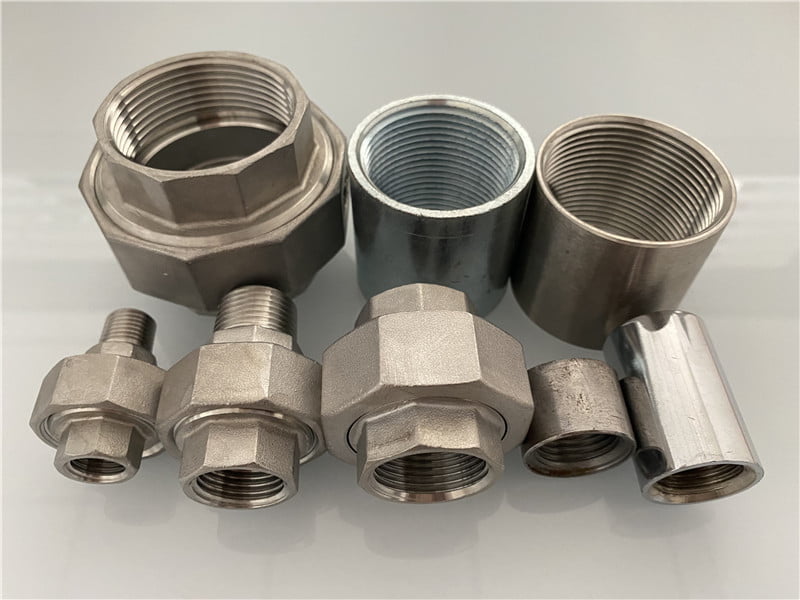
pipe coupling is a
female-threaded fitting used to connect two male-threaded pipes or fittings.
Unlike a pipe nipple, a coupling does not extend the pipeline. Instead, it joins two externally threaded components into a continuous connection.
Because of its simple structure, the coupling is widely used in residential plumbing, fire protection systems, industrial piping, compressed air systems, and mechanical installations.
Typical materials include:
- Carbon steel
- Galvanized carbon steel
- Stainless steel
- Brass
Depending on the project, couplings may be supplied as:
- Full Coupling
- Half Coupling
- Reducing Coupling
- Socket Coupling
Industrial buyers usually specify the material grade, thread standard, pressure requirement, and surface finish before placing an order.
Pipe Nipple at a Glance
A
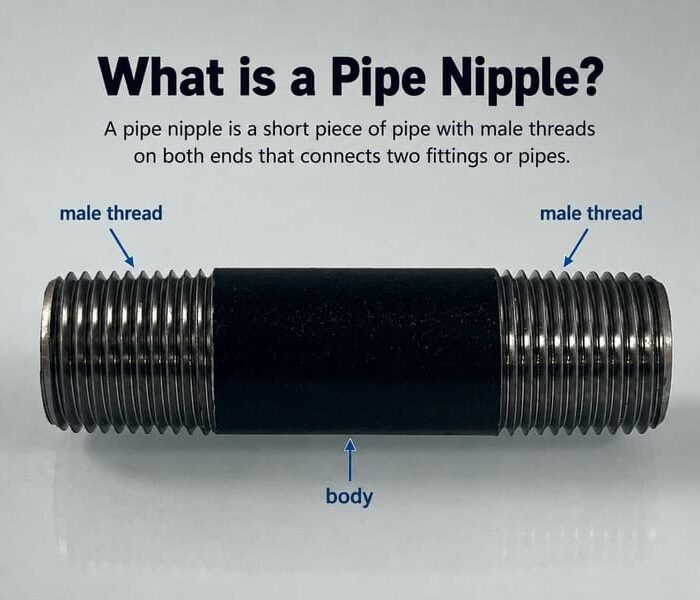
pipe nipple is a
male-threaded section of pipe with threads on one or both ends.
Instead of connecting two male threads together, a pipe nipple extends or connects piping by engaging with female-threaded fittings such as couplings, elbows, tees, valves, or unions.
Pipe nipples are available in numerous lengths and configurations, including:
- Close Nipple
- Barrel Nipple
- Hex Nipple
- Weld Nipple
- Shoulder Nipple
- Hose Nipple
- TBE (Thread Both Ends) Nipple
Material options are generally the same as pipe couplings, but pipe nipples offer much greater flexibility in terms of length and customization.
For export projects, custom lengths are frequently manufactured according to engineering drawings or project specifications.
Pipe Coupling vs Pipe Nipple: Understanding the Fundamental Difference
Although these fittings are often installed together, they perform different functions within a piping system.
The easiest way to understand the difference is to think about
how they interact with pipe threads.
A coupling receives threads internally.
A pipe nipple provides threads externally.
This simple distinction determines where each fitting can be used.
For example:
Imagine two threaded steel pipes that need to be joined together.
Since both pipes already have external threads, another externally threaded fitting cannot connect them.
Instead, a female-threaded coupling is required.
Now consider a threaded valve that needs to be installed several inches away from a pipe elbow.
A short pipe nipple is installed between the two fittings to provide the required extension.
Although both components are threaded fittings, they solve completely different installation problems.
Comparison Table
| Feature |
Pipe Coupling |
Pipe Nipple |
| Thread Type |
Female Thread |
Male Thread |
| Primary Function |
Connect Two Male Threads |
Extend or Connect Threaded Components |
| Standard Length |
Very Short |
Various Lengths Available |
| Thread Position |
Internal |
External |
| Common Materials |
Carbon Steel, Galvanized Steel, Stainless Steel |
Carbon Steel, Stainless Steel, Brass |
| Custom Length |
Rare |
Very Common |
| Installation Purpose |
Joining Pipes |
Extending Pipe Connections |
| Used With |
Male Threaded Pipes |
Female Threaded Fittings |
For buyers unfamiliar with threaded fittings, this comparison provides a quick reference when reviewing product catalogs or preparing procurement lists.
Where Is a Pipe Coupling Used?
Pipe couplings are commonly selected when two externally threaded pipes or fittings must be joined securely.
Typical applications include:
- Commercial plumbing systems
- Water distribution pipelines
- Fire sprinkler installations
- Compressed air systems
- Irrigation networks
- Industrial utility piping
Because couplings have no extended body, they occupy minimal installation space and provide a compact threaded connection.
In maintenance projects, replacing a damaged coupling is usually faster than replacing an entire section of pipe, making it a cost-effective fitting for repair work.
Where Is a Pipe Nipple Used?
Pipe nipples are selected whenever additional threaded length is required between fittings.
Common examples include:
- Connecting valves to pipelines
- Extending threaded outlets
- Pressure gauge installations
- Pump connections
- Boiler systems
- Gas piping
- Hydraulic equipment
- Chemical process piping
Unlike couplings, pipe nipples are available in many standard and custom lengths, allowing engineers to achieve precise spacing between connected components.
For this reason, distributors often stock multiple nipple lengths while keeping fewer coupling variations in inventory.
Material Comparison: Does the Material Matter More Than the Fitting Type?
When comparing a pipe coupling with a pipe nipple, many buyers focus on the fitting type first. In reality, the material often has a greater impact on long-term performance than whether the fitting is a coupling or a nipple.
The correct material should always be selected according to the operating environment rather than simply matching the existing pipeline.
Carbon Steel
Carbon steel is one of the most widely used materials for threaded pipe fittings because it offers high mechanical strength and an economical cost.
It is commonly used in:
- Compressed air systems
- Mechanical equipment
- Oil and gas pipelines
- Industrial machinery
- Structural piping
However, untreated carbon steel is susceptible to corrosion in humid or outdoor environments.
Galvanized Carbon Steel
Galvanized fittings are carbon steel products coated with zinc to improve corrosion resistance.
Galvanized pipe nipples and couplings are widely used in:
- Water supply systems
- Fire sprinkler systems
- Outdoor installations
- Agricultural irrigation
- HVAC piping
Although galvanized fittings cost slightly more than black steel fittings, the additional corrosion protection often results in a longer service life and reduced maintenance.
Stainless Steel
Stainless steel provides the highest level of corrosion resistance among commonly used threaded fitting materials.
Typical applications include:
- Food processing
- Pharmaceutical plants
- Marine environments
- Chemical processing
- High-humidity facilities
Grades such as
304, 304L, 316, and 316L are selected according to corrosion requirements and project specifications.
Although stainless steel fittings are more expensive, they are often the most economical choice over the lifetime of the system because of their durability and reduced maintenance.
Brass
Brass pipe nipples and couplings are frequently used where corrosion resistance and machinability are important.
They are commonly found in:
- Potable water systems
- Instrumentation
- Low-pressure gas systems
- Plumbing fixtures
Brass is also less likely to seize than stainless steel threads, making installation and future maintenance easier.
Thread Standards: Compatibility Is Critical
Choosing the correct thread standard is just as important as choosing the fitting itself.
Two fittings of the same size but different thread standards may appear compatible at first glance, yet fail to seal properly or even damage each other during installation.
The most common thread standards include:
Different regions generally follow different standards.
For example:
- North America primarily uses NPT threads.
- Many European countries commonly use BSPP or BSPT.
- Some Middle Eastern and Asian projects specify either standard depending on project requirements.
Before placing an order, buyers should always confirm:
- Thread type
- Nominal pipe size
- Pressure class
- Applicable standard
Failing to verify these details can result in installation delays, costly replacements, and unnecessary freight expenses.
Common Purchasing Mistakes Buyers Should Avoid
After supplying threaded fittings to customers in different industries, we have noticed several purchasing mistakes that occur repeatedly.
Avoiding these issues can save considerable time and cost during installation.
Mistake 1: Ordering by Thread Size Only
Many buyers specify only a thread size, such as 1 inch or 2 inches.
However, this information alone is insufficient.
A complete specification should also include:
- Material
- Thread standard
- Surface finish
- Length (for nipples)
- Applicable standard
Mistake 2: Assuming All Threads Are Compatible
A 1-inch NPT fitting is not interchangeable with a 1-inch BSP fitting.
Although they may appear similar, differences in thread angle and pitch prevent a proper seal.
Always verify the required thread standard before ordering.
Mistake 3: Selecting the Wrong Nipple Length
Pipe nipples are manufactured in many standard lengths.
Choosing a nipple that is too short may prevent proper assembly.
Choosing one that is too long can interfere with adjacent equipment or increase stress on the piping system.
Review engineering drawings or installation clearances before confirming the required length.
Mistake 4: Ignoring Corrosion Conditions
Carbon steel fittings installed in highly corrosive environments often require frequent replacement.
In many cases, upgrading to galvanized or stainless steel fittings provides a better long-term solution.
Material selection should be based on operating conditions rather than purchase price alone.
How to Decide Between a Pipe Coupling and Nipple
A simple way to choose is to begin with the function you need the fitting to perform.
Choose a
pipe coupling if you need to:
- Join two male-threaded pipes
- Repair or reconnect a threaded pipeline
- Create a compact connection with minimal additional length
Choose a
pipe nipple if you need to:
- Extend a threaded connection
- Connect valves, gauges, or equipment
- Create spacing between threaded fittings
- Use a custom connection length
In many industrial systems, both fittings are used together.
For example, a valve assembly may include two pipe nipples connected by a coupling, providing both extension and secure joining in a single installation.
Manufacturing Perspective: Why Consistency Matters
From a manufacturer’s perspective, producing high-quality threaded fittings requires more than simply cutting threads onto steel pipe.
Consistency is essential.
Every batch should maintain:
- Accurate dimensions
- Uniform thread quality
- Smooth surface finish
- Reliable coating thickness
- Stable material properties
At SANVO, every production stage—from raw material selection to CNC thread machining and final inspection—is controlled to ensure each fitting meets the specified requirements.
This manufacturing consistency becomes especially important for distributors and OEM customers, who rely on repeat orders with identical specifications and performance.