When purchasing steel pipes, buyers often need to compare ERW vs seamless pipe.
They have similar functions, but their manufacturing processes, features, and applications are different.
Selecting the wrong pipe type may increase costs or result in unsuitable performance.
For example, a general water pipeline may not require seamless pipe, while high-pressure and high-temperature applications may require seamless construction.
We supply steel pipes, including material grade, manufacturing process, standards, and application conditions.
This guide explains the key differences between ERW pipe vs seamless pipe to help buyers.
What Is ERW Steel Pipe?
ERW stands for Electric Resistance Welded pipe.
Flat steel is formed into a round shape and joined via electrical resistance welding.
The main production steps include:
- Steel coil preparation
- Roll forming
- Edge heating
- Electric resistance welding
- Inspection and finishing
Because ERW production uses automated welding technology, it provides:
- Consistent dimensions
- High production efficiency
- Competitive pricing
ERW steel pipes are widely used in:
- Water transportation
- Fire sprinkler systems
- Structural applications
- Mechanical piping
- General industrial systems
What Is Seamless Steel Pipe?
Seamless steel pipe is manufactured without a welded seam.
Seamless steel pipe is produced from solid billets rather than welded plates.
The manufacturing process typically includes:
- Billet heating
- Piercing
- Rolling
- Sizing
- Heat treatment
- Inspection
Seamless pipes excel in demanding environments without welded joints.
Common applications include:
- Oil and gas systems
- High-pressure pipelines
- Boilers
- Power plants
- Chemical processing equipment
ERW vs Seamless Pipe: Main Differences
| Feature | ERW Pipe | Seamless Pipe |
|---|---|---|
| Manufacturing | Welded from steel strip | Made from solid billet |
| Weld Seam | Present | No weld seam |
| Production Cost | Lower | Higher |
| Dimensional Accuracy | Excellent | Excellent |
| Pressure Capability | Suitable for many applications | Better for extreme conditions |
| Production Efficiency | Higher | Lower |
| Common Use | General industrial piping | High-pressure applications |
Manufacturing Process Comparison
ERW Pipe Production
ERW manufacturing is highly efficient because steel coils can be continuously processed.
Advantages:
- Fast production speed
- Lower material waste
- Competitive pricing
- Suitable for large-volume orders
Modern ERW technology provides excellent weld quality through:
- Automatic control systems
- Non-destructive testing
- Dimensional inspection
Seamless Pipe Production
Seamless manufacturing requires more complex processing.
The billet must be heated and pierced before being rolled into a hollow pipe.
Advantages:
- Uniform structure
- Excellent pressure resistance
- Suitable for extreme environments
However, the manufacturing process requires more equipment and energy, resulting in higher production costs.
Strength Comparison: Is Seamless Always Stronger?
Many buyers assume seamless pipe is always stronger than ERW pipe.
This is not always correct.
Modern ERW pipes can achieve excellent mechanical performance when manufactured according to proper standards and quality controls.
The actual performance depends on:
- Material grade
- Wall thickness
- Manufacturing standard
- Inspection requirements
- Application conditions
For normal industrial applications, high-quality ERW pipe can provide reliable performance.
For high-temperature or high-pressure applications, seamless pipe is often preferred.
Application Comparison
ERW Steel Pipe Applications
Common uses:
- Fire protection systems
- Water pipelines
- HVAC systems
- Mechanical structures
- General industrial piping
ERW is often selected because it provides a good balance between:
- Performance
- Availability
- Cost
Seamless Steel Pipe Applications
Common uses:
- Oil and gas industry
- Pressure vessels
- Chemical processing
- Power generation
These industries require pipes capable of handling:
- High pressure
- High temperature
- Continuous operation
Cost Difference Between ERW And Seamless Pipe
Cost is one of the most important factors for buyers.
Generally:
ERW pipe is more economical.
Reasons include:
- Higher production efficiency
- Lower manufacturing cost
- Better material utilization
Seamless pipe costs more because:
- Production is more complex
- Equipment investment is higher
- Manufacturing cycle is longer
However, selecting based only on price may create problems.
The correct choice should consider:
- Operating conditions
- Safety requirements
- Long-term maintenance cost
How To Choose Between ERW And Seamless Pipe?
Choose ERW pipe when:
- The application is general industrial use
- Cost efficiency is important
- Pressure requirements are moderate
- Large quantities are required
Choose seamless pipe when:
- High pressure is involved
- High temperature service is required
- Critical industrial applications are involved
Before ordering, buyers should confirm:
- Pipe standard
- Material grade
- Wall thickness
- Application requirements
Relationship Between Steel Pipes And Pipe Fittings
A complete piping system requires compatibility between pipes and fittings.
For example:
A carbon steel piping system may include:
- ERW or seamless pipe
- Pipe nipples
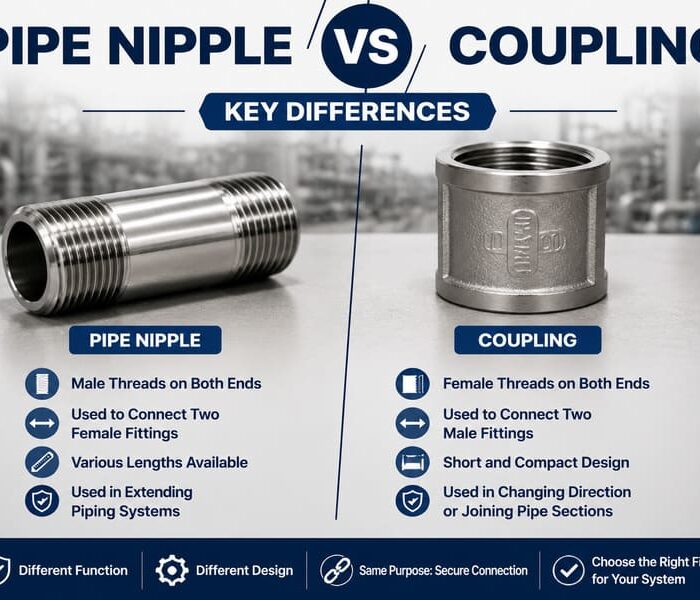
- Couplings
- Elbows
- Flanges
- Valves
The selected components should match in:
- Material
- Pressure rating
- Connection method
- Applicable standards
SANVO Manufacturing Capability
As a manufacturer of steel pipes and pipe fittings, SANVO provides solutions for different industrial applications.
Our production capability covers:
- Carbon steel pipes
- Galvanized steel pipes
- Threaded pipe fittings
- Pipe nipples
- Pipe couplings
We help customers select suitable products according to:
- Application requirements
- International standards
- Project specifications
Conclusion
ERW and seamless steel pipes are both important products used in piping systems.
ERW pipes are economical, while seamless pipes suit high-pressure and high-temperature environments.
Understanding the differences in their manufacturing processes helps select the correct pipe and decrease costs.